
Every few weeks someone at the gift shop asks me some version of the same question: my grandson just turned four, should I get him The Zonderkidz Beginner's Bible or The Action Bible? Or the reverse: my daughter is eight and loves graphic novels, which one actually holds her attention? These are good questions. Both books are real, both are beloved, and buying the wrong one for the wrong age is genuinely frustrating for a parent who wanted to make scripture feel alive for a child.
The short answer: if your child is between ages two and seven, The Zonderkidz Beginner's Bible (Zonderkidz, 4.9 stars across 28,533 reviews) is the right choice. If your child is eight or older and already reading chapter books independently, The Action Bible becomes worth a look. The two books are not really competing for the same child. They are built for different developmental stages, different attention spans, and different relationships with illustration. What follows is the full comparison so you can buy once and get it right.
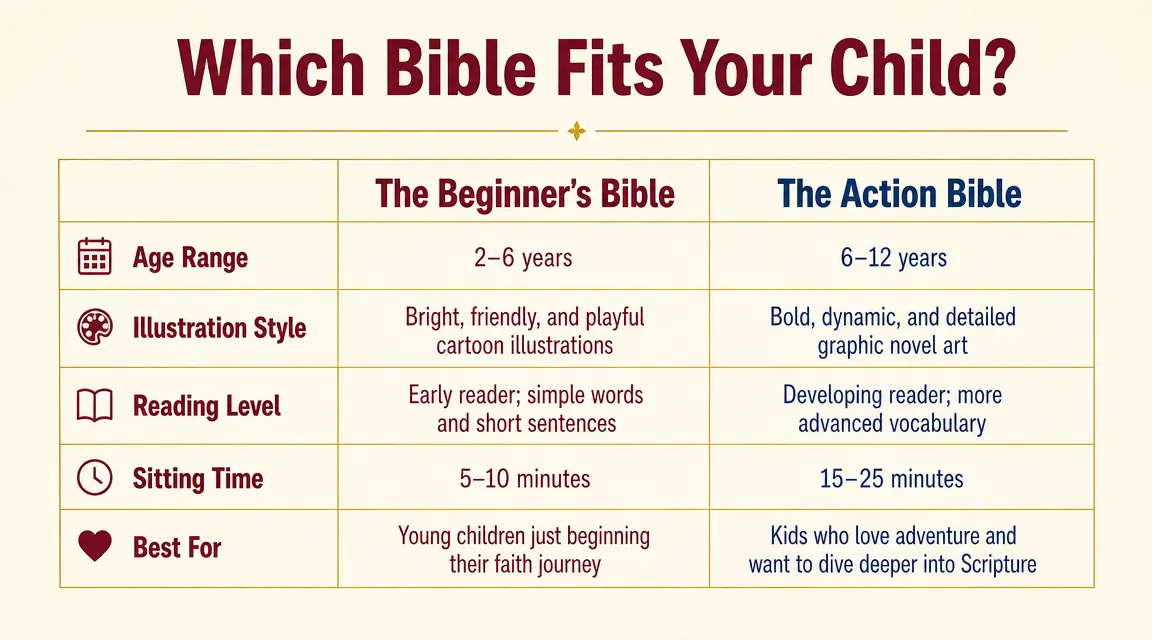
| The Beginner's Bible | The Action Bible | |
|---|---|---|
| Publisher | Zonderkidz | David C Cook |
| Best Age Range | Ages 2 to 7 | Ages 8 and up |
| Illustration Style | Soft, rounded, full-color cartoons | Full graphic-novel panels, action lines, dramatic color |
| Reading Level | Read-aloud (adult reads to child) | Independent reader or guided read-aloud |
| Stories Included | 95+ simplified Bible stories | 215 graphic-novel story arcs spanning Old and New Testament |
| Average Sitting Time | 3 to 8 minutes per story, ideal for bedtime | 15 to 40 minutes per chapter, better for independent reading |
| Gift Appeal for Toddlers and Preschoolers | Outstanding | Not appropriate (visual complexity overwhelms) |
| Gift Appeal for School-Age Readers | Good for ages 4-7; may feel "young" to a 9-year-old | Strong for ages 8-12 |
| Amazon Rating | 4.9 stars / 28,533 reviews | 4.8 stars / ~12,000 reviews |
| Amazon Link | Available | Named alternative only (no affiliate link) |
Where The Beginner's Bible Wins: The First Four to Seven Years of Faith
The Zonderkidz Beginner's Bible has been around since 1989 and has sold over 25 million copies. That kind of longevity in a children's publishing market does not happen by accident. The book earns its place on the shelf by doing one thing exceptionally well: meeting a two-to-seven-year-old exactly where they are cognitively and emotionally.
The illustrations are soft, rounded, and warm. No sharp angles. No action lines. No jarring panel cuts. A four-year-old named Ella who sees Noah on the ark sees a kind, bearded man surrounded by friendly-looking animals in a picture that feels safe to look at. The color palette across the 95-plus stories is consistently cheerful without being overstimulating. That matters at bedtime. A book that winds a child down rather than revving them up is worth a great deal to a tired parent.
The text is written for read-aloud, which means an adult does the reading while the child looks at the pictures and asks questions. Stories run three to five minutes from first word to last. That length is calibrated to match the attention span of a preschooler without cutting the story so short it loses meaning. Creation, Noah's ark, Moses and the burning bush, the birth of Jesus, the empty tomb: every major narrative is here, simplified but not distorted. Parents who have read the stories find that children can retell them independently within a few weeks of regular reading. That is how scripture gets into a small person.
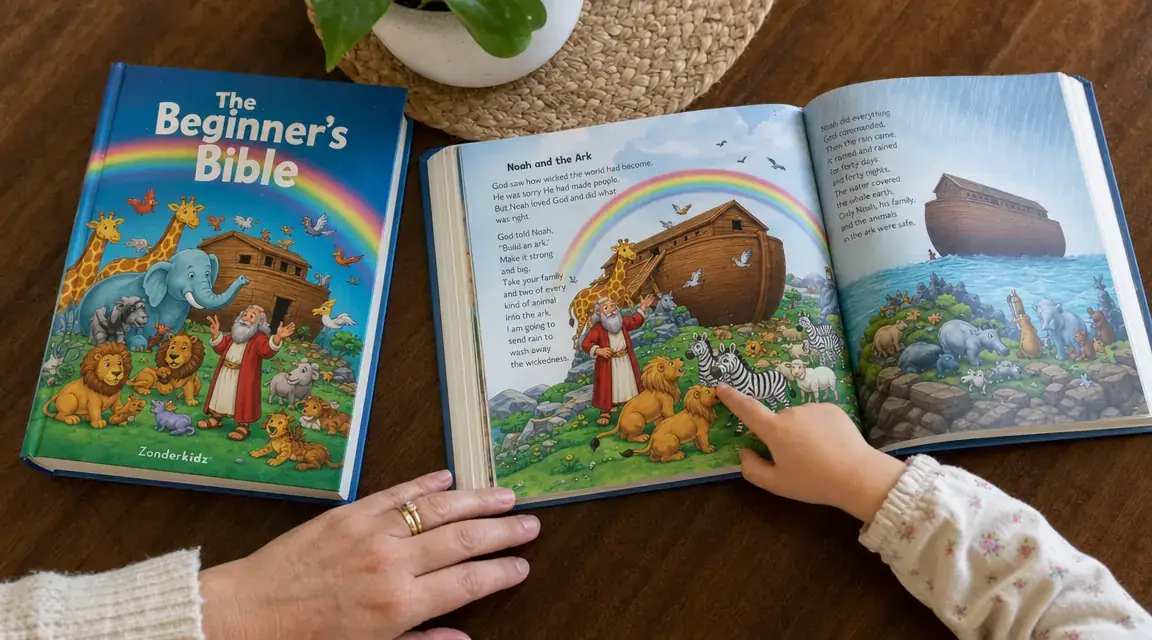
For gift-giving specifically, The Beginner's Bible holds up as a physical object. The binding is durable. The pages are thick enough to survive a toddler's handling. Grandparents who write an inscription inside the front cover are giving something that may be read hundreds of times before the child ever opens a grown-up Bible. That durability and the book's reputation, established across two generations of Christian families, makes it the safer, more confident gift for a young child. You can read our long-term review of The Beginner's Bible for a full accounting of what six months of nightly reading with a four-year-old actually looks like.
Where The Action Bible Wins: The Eight-and-Up Independent Reader
The Action Bible, published by David C Cook, is a legitimate Bible story resource for older children. It covers 215 Old and New Testament stories in a full graphic-novel format: dramatic panel layouts, action-oriented line work, expressive character faces, and the kind of kinetic visual energy you find in a serious comic book. For a child who is already reading graphic novels independently and is eight years old or older, this format can be genuinely engaging in a way that a read-aloud storybook is not.
The Action Bible works because older children who have outgrown being read to at bedtime need a different on-ramp to scripture. The graphic-novel format demands more of the reader: tracking multiple panels, reading dialogue in speech bubbles, following sequential action across a page spread. A ten-year-old who loves comics and has been told that the Bible is just an old book may pick up The Action Bible out of curiosity and find themselves reading through the story of Samson or Daniel or Paul's shipwreck in a way that a dense text page would never capture. That is a real gift.
A four-year-old does not need her Bible to be dramatic. She needs it to be warm, safe, and short enough to hold her attention before her eyes grow heavy. The Beginner's Bible was built for that exact child.
The Age Range Is the Only Decision That Matters
When parents ask me which book to choose, the only follow-up question I ask is this: how old is your child? If the answer is seven or younger, I point to The Beginner's Bible without hesitation. If the answer is eight or older and the child reads independently, The Action Bible becomes a reasonable conversation. But I want to be honest about one thing many people miss: a six-year-old cannot actually engage with The Action Bible's visual language. Graphic novels require a level of visual literacy, sequential thinking, and reading fluency that most children are not ready for until second or third grade at the earliest.
The reverse concern, that a seven-year-old will find The Beginner's Bible too young, is worth acknowledging too. In my experience, children who have been read The Beginner's Bible from age two onward often still love it at six and seven, because the stories feel familiar and comforting, not childish. But a child who receives it for the first time at age eight may feel it is too simple. Know your child.
Illustration style is the second factor. The Beginner's Bible uses broad, rounded, approachable cartoon art. The Action Bible uses the detailed, high-contrast line art of a professional graphic novel. Some children respond deeply to color-saturated realism; others find it overstimulating. For children under seven, the rounded gentle illustrations of The Beginner's Bible are developmentally appropriate. The Action Bible's dramatic style is best understood by a child who already knows what graphic novels look like and enjoys them.
Your 2-to-7-year-old needs The Beginner's Bible. Nearly 29,000 families agree.
The Beginner's Bible has been the most trusted first scripture resource for young children for over three decades. If you are buying for a preschooler, toddler, or early-elementary child, this is the one. Durable binding, illustrated stories they will remember for life, and short enough for bedtime.
Amazon Check Today's Price on Amazon →Reading Level and Attention Span: What the Data Actually Shows
The Beginner's Bible stories average roughly 300 to 500 words each. That is the right length for a child with a four-to-eight-minute attention span, which describes most two-to-six-year-olds at their best. Each story has a clear beginning, middle, and end. The language is simple enough that a child can follow it without needing to understand every word, and the accompanying illustrations provide constant context clues. Reading aloud to a preschooler from The Beginner's Bible is a natural, low-effort experience that can become a nightly ritual without burning the parent out.
The Action Bible operates on an entirely different scale. Individual story chapters span full 10-to-15-page sections. Reading a complete episode, say, the story of David and Goliath as rendered in graphic-novel format, takes twenty to thirty minutes for an independent reader. That is not a criticism. It is a description of the format's intended audience: a child who can sustain focus independently for the length of a comic-book chapter. Sitting a five-year-old in front of The Action Bible and hoping she follows along is like sitting that same child in front of a chapter book and expecting her to read silently. The format does not match the developmental stage.
Who Should Buy The Beginner's Bible
Buy The Beginner's Bible if you are shopping for a child between ages two and seven, a grandparent who wants to read Bible stories aloud to young grandchildren, a parent establishing a nightly scripture routine with a preschooler, or anyone seeking a baptism or baby-dedication gift that will actually be used. This is the book that ends up on every nightstand in homes where faith is passed down one story at a time. It is the Bible equivalent of a well-loved children's classic: something a child will remember long after they have moved on to grown-up reading. For practical guidance on making the most of reading time with young children, see our guide on how to read Bible stories with young children.
Who Should Skip The Beginner's Bible
If the child you are shopping for is eight or older and reads chapter books independently, The Beginner's Bible may not be the best fit, not because it is poorly made, but because the format is designed for a different stage of life. A third-grader who reads Diary of a Wimpy Kid on her own may find the simple text and cartoon illustrations feel too young. In that case, The Action Bible's graphic-novel format gives scripture a visual language she already respects. Similarly, if you are shopping for a child who already owns The Beginner's Bible and has had it for several years, The Action Bible makes a meaningful next step rather than a duplicate.
The Beginner's Bible: 28,000+ families have made this their child's first scripture book.
If your child is two to seven years old, this is the clearest recommendation I can make. The illustrated stories are developmentally right, the length fits bedtime, and the book is durable enough to last through multiple children in the same family. It is the kind of gift that a grown child will one day pull off their parents' shelf and read to their own kids.
Amazon Check Today's Price on Amazon →