
I want to be honest with you about something before you add The Zonderkidz Beginner's Bible to your cart. I have recommended this book more times than I can count, across twenty years of running a church gift shop and another three years writing about faith gifts online. My granddaughter Clara, who just turned five, has a copy with a cracked spine from so much use. I am not writing this to talk you out of it. I am writing it because the five-star reviews that make up that 4.9-star average on Amazon leave out a few things that actually matter, depending on how old the child is and what you're hoping a children's Bible will do.
Twenty-eight thousand reviews is a significant signal. It tells you this book has found its way into a lot of homes and done something right in them. But most of those reviews come from parents whose children were between two and five when they first opened it. By the time the same child turns eight and notices that David's killing of Goliath is described in three gentle sentences, nobody goes back and updates their review. That gap is what this article tries to fill.
The Quick Verdict
The best illustrated children's Bible for ages two through six, with real limitations past that window that most reviews never mention.
Amazon Check Today's Price →Your two-to-six-year-old will wear this book out. Here's where to get the current edition.
The Beginner's Bible from Zonderkidz has 4.9 stars from over 28,000 families. It is the most-gifted children's Bible on Amazon for good reason. Check the current edition and today's price before ordering.
Amazon Check Today's Price on Amazon →How I Have Used This Book and Observed It in Others
I first encountered The Zonderkidz Beginner's Bible in 1994, when a mother came into our church gift shop asking for something her three-year-old could understand. We ordered a copy, fell in love with it ourselves, and it has been a permanent shelf fixture ever since. In that time I have watched three full generations of children in our congregation grow up with this book. I have gifted it at baby showers, baptisms, first Christmases, and Easter baskets. I have also seen the same children at seven or eight years old, their parents quietly looking for something with more weight to it.
My granddaughter Clara received her copy at age two from her other grandmother. She is five now and still asks for it by name at bedtime. That is a good three-year run for a picture book, which tells you something about the staying power of the Zonderkidz illustrations and the pacing of the stories. I have read at least forty of the ninety-three stories aloud. I know the text well enough to notice where it has been simplified, where the illustrations carry content the words leave out, and where the choices made by the editors back in 1989 are starting to show their age.
What the Twenty-Eight Thousand Reviews Get Right
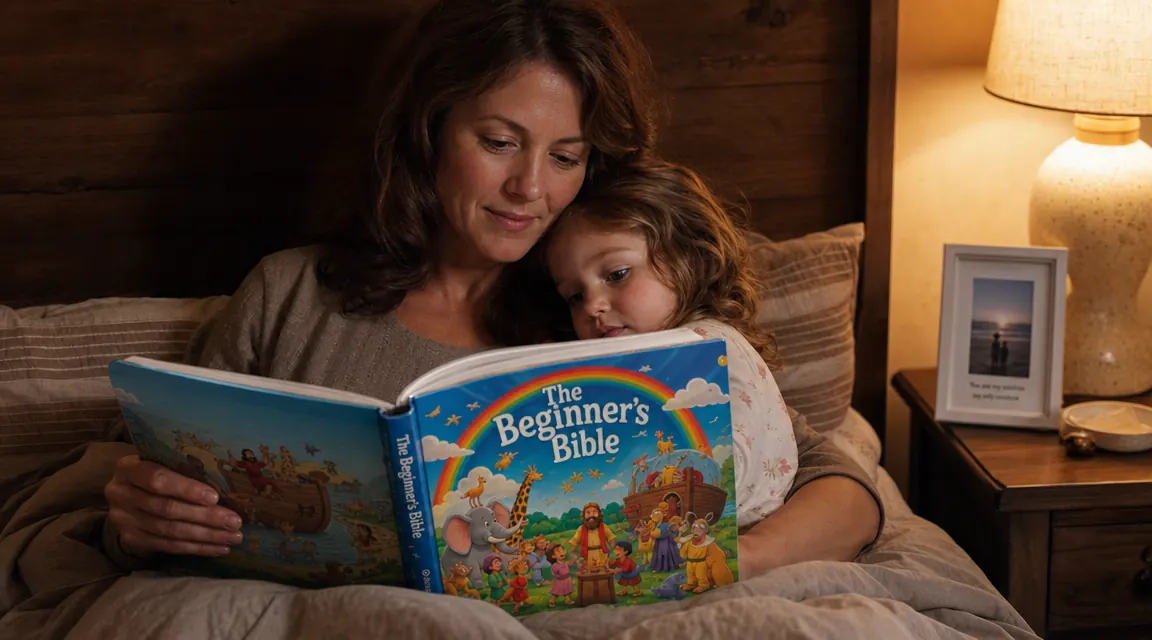
The illustrations work. That is the short version. The art style by Kelly Pulley uses rounded shapes, warm earthy tones, and faces that read as expressive even from a distance. Characters have a consistency across stories so a three-year-old begins to recognize Noah, Moses, and Jesus as recurring figures rather than strangers who appear and disappear. That continuity is not common in children's Bibles. Many competing titles use a rotation of illustrators, which creates visual whiplash that small children find genuinely confusing.
The story count also matters. Ninety-three stories is ambitious for a children's Bible at this age level. The book covers both Old and New Testament, which means a child who is read to nightly will move through the complete arc of scripture over the course of a few months. That arc from creation through the early church is harder to find in shorter-form children's devotionals. Parents tell me all the time that their children, after a year with this book, can name major figures and events in sequence. That biblical literacy foundation is real, and it transfers.
The physical format holds up. The 2016 updated edition uses a binding that survives the kind of treatment a four-year-old applies to a favorite book. Corners get chewed. Covers get dragged across floors. Wet fingers turn pages. The full-color printing on slightly thicker-than-average pages means the images stay sharp even after rough handling. Parents in the one-star reviews you will find on Amazon are almost entirely about older print runs from the 1990s, whose binding glue separated at the spine. That issue was corrected in later editions. Order new, not used, and you will not encounter it.
What the Reviews Leave Out: The Paraphrasing Question
Here is the thing nobody says plainly: The Beginner's Bible is not a Bible translation. It is a retelling. The stories are paraphrased and condensed into simple vocabulary, which is the right choice for a two-year-old and a fair compromise for a four-year-old. But parents who are hoping their child is absorbing actual scripture should know that the words their child is hearing are not the words of any translation. 'God made the world' is the level of textual specificity you get, not Genesis 1:1 in even the simplest translation like the NIrV.
That is not a criticism of the editorial choice, which was intentional and appropriate for the stated audience. It becomes relevant when a parent tells me their six-year-old 'knows the Bible really well' because of this book. The child knows the stories. Those are different things at that age. If scriptural memory, actual verse exposure, or translation-based reading is the goal, The Beginner's Bible is a warm-up, not the destination. It builds familiarity with the narrative. The actual text of scripture comes later, with a different book.
The Beginner's Bible is a retelling, not a translation. That is the right call for a two-year-old. It becomes worth knowing if your child is six and you are hoping for scripture memorization to begin.
The Illustration Style: Warm, But Dated
The art in The Beginner's Bible originated in 1989. The 2016 update refreshed the cover and a handful of interior pages, but the core illustration style is unchanged. For children under six, this does not matter at all. They respond to faces, color, and visual clarity, and this book delivers all three. For parents who have grown up with modern children's picture book illustration, the style will feel noticeably older. Lines are softer and less detailed than contemporary picture books. Color palettes lean toward the earthy, muted side rather than the saturated primaries of modern illustration.
I have not once heard a child under six comment on this. The concern, when it exists, comes from adults. If you are buying this for a child, set aside your own aesthetic reaction and watch how the child responds to the actual pages. In my experience, children connect with faces, and this book draws faces that communicate clearly. Whether the background details feel dated to a thirty-five-year-old parent is not relevant information to the three-year-old turning the pages.
The Age Ceiling Nobody Mentions
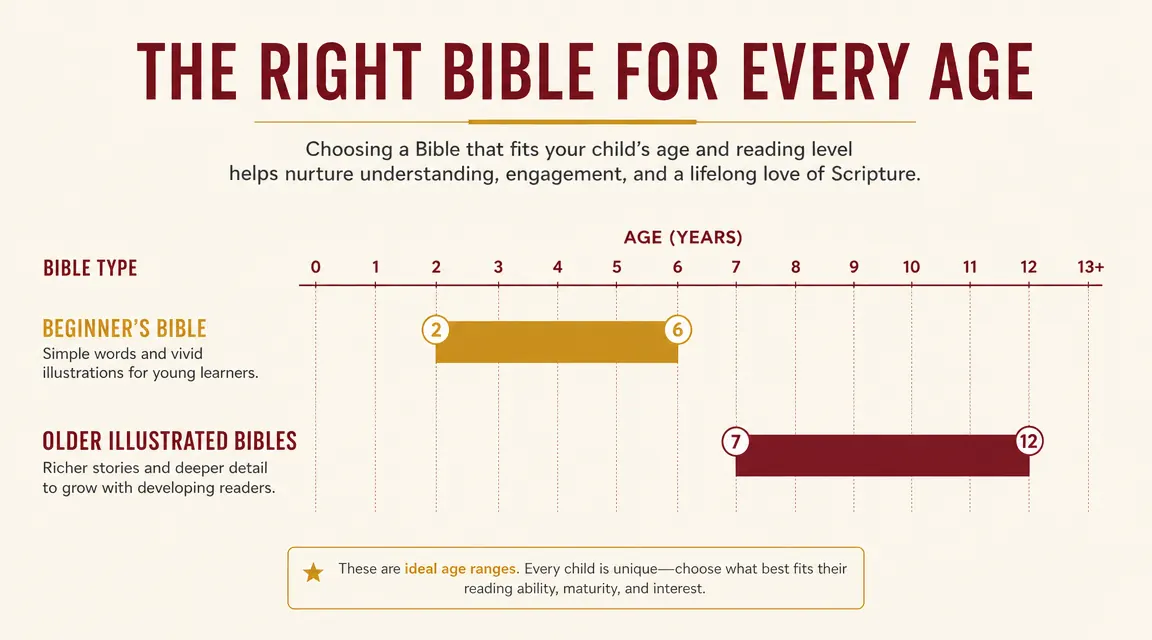
The packaging says ages four and up. That is technically defensible but it does not tell you when the book stops working. In my observation, the upper limit is closer to six or seven, and six is generous. At seven, most children have moved beyond board-book-level illustration and want more detail, more dialogue, more plot. The condensed retellings in The Beginner's Bible, which are appropriate and necessary for a two-year-old, feel thin to a second-grader who is reading chapter books independently.
This matters for gift-givers, not parents. If you are a grandparent, aunt, or friend buying a children's Bible for a child you do not see regularly, do not guess on age. A five-year-old and a seven-year-old are two entirely different readers for this book. For a seven-year-old, something like The Action Bible or even a children's illustrated NIrV is a better fit. The Beginner's Bible, given to a seven-year-old, will likely sit unopened within a month. I have seen it happen. See the comparison article on this site for a full breakdown of which children's Bible fits which age window.
How It Handles Difficult Bible Stories
The Beginner's Bible softens the hard material. Significantly. The death of the Egyptian firstborn is mentioned but not described. The crucifixion focuses on the resurrection in a way that gives very young children a sense of loss followed quickly by joy, with the suffering condensed to a few lines. Goliath falls. The text does not dwell on the beheading. Lot's wife becomes a pillar of salt, full stop, with no description of the scene. Sodom and Gomorrah are referenced as places where people 'did not obey God,' which is accurate but leaves out everything that makes that story theologically and historically significant.
I think this is the right call for a two-year-old. I am less certain it is the right call for a six-year-old whose parents want to begin honest conversations about sin, consequence, and redemption. Parents who use this book as the only scripture source for a five or six-year-old may find that their child has a version of the Bible that is mostly gentle and occasionally vague. That version will eventually need updating. This book sets the table. It does not serve the full meal, and it was never designed to.
The Newer Edition vs Older Printings
If you search used book markets, you will find older editions of The Beginner's Bible at a lower price point. The warning here is specific: editions printed before roughly 2010 used a binding adhesive that dried out and failed. The spine cracked. Pages fell out. One-star reviews on Amazon mentioning pages 'falling apart after two weeks' are almost always describing these older copies, not the current printing. The 2016 and later editions use a substantially improved binding. Order new, from Amazon directly, and you will receive the current edition with the improved construction.
The content itself has not changed significantly between editions. The stories, illustrations, and story count are the same. The Zonderkidz team did not revise the theological content or simplification level in the 2016 update. So if you are asking whether a newer edition is somehow more accurate or more complete than an older one, the answer is no. The newer edition simply holds together better under the kind of use a toddler applies to a favorite book.
What I Liked
- Ninety-three stories cover both Old and New Testament, giving young children the full biblical arc
- Consistent illustrations across all stories help toddlers recognize recurring characters
- 2016 and later editions use durable binding that survives years of daily use
- Pacing and vocabulary are genuinely calibrated for ages two through five
- One of the best-selling children's Bibles in the market, meaning teachers and grandparents often already know it
Where It Falls Short
- Paraphrased retellings, not actual scripture text, so memorization does not translate to verse knowledge
- Illustration style dates to 1989 and looks noticeably older than contemporary picture books
- Age ceiling is closer to six or seven than the 'ages four and up' packaging suggests
- Violent and morally complex stories are softened to the point of losing some theological substance
- Older print runs have documented binding failures; buying used carries meaningful risk
Who This Book Is For
This book is for children between eighteen months and six years old who are being introduced to the stories of scripture for the first time. It is for parents who want a read-aloud that covers the full biblical narrative without requiring them to adapt adult-level text on the fly each evening. It is for grandparents who want to give a gift that has a 30-year track record of landing well. It is for Sunday School teachers stocking a classroom shelf and for families building a first faith library. For all of those uses, it is genuinely the best option at its age range.
Who Should Skip It
Children who are already reading independently at a chapter-book level are past this. A seven-year-old who reads Junie B. Jones on their own does not need illustrations designed for a child who cannot yet hold a pencil. Parents who want their child to memorize actual scripture text need a different tool, ideally a children's translation like the NIrV paired with a verse-memorization curriculum. Parents of children who are theologically curious and already asking harder questions about why bad things happen and what death means will find this book's soft handling of those subjects leaves the conversations half-finished. And anyone considering a used copy should think carefully about the binding history.
For ages two through six, nothing competes with this book's track record. See today's price.
The Beginner's Bible has introduced more children to scripture than almost any other illustrated children's Bible in the last thirty years. If the child in your life is in that sweet spot between toddler and early elementary, this is the place to start. Check the current edition on Amazon before your order.
Amazon Check Today's Price on Amazon →